How to Build Your System
By OSJJ
Open Source Jiu-Jitsu
THE CURRICULUM SERIES · PART THIRTEEN
How to Build Your System
What you believe is true in every position, what your game organizes around, and the connections between the things you already teach, written down and said out loud. Four systems that did it four different ways, six questions to answer in order, and one built in front of you.
Justin Hall / Co-Founder, Open Source Jiu-Jitsu
The last two pieces built an hour and showed how to deliver it. This one steps out of the hour and builds the thing the hour sits inside. Curriculums and Systems, in the first half of the series, drew the distinction: a curriculum is the order you teach things in, and a system is the layer above it, what you believe is true in every position, what the game organizes around, and the connections between the techniques you already teach, made out loud so the student stops collecting moves and starts understanding a game. That piece ended with four steps for adding a system to a curriculum you already have. This piece is those steps done properly, with worked examples, in the order a coach should take them.
Two boundaries. This is not a technique article and it is not a curriculum article. Which techniques you teach is your business, and the order you teach them in belongs to the four curriculum pieces that close the series. It is also not the map. Mapping the System showed four maps of four systems and promised a build piece for the drawing; that is the next article. You cannot draw what you have not decided, and this piece is the deciding. What comes out of it is not a document anyone reads. It is a short set of answers a coach can say in class, every class, until the room can say them back.
One picture of that layer, since it is the hardest one to see.
Techniques are vocabulary. A curriculum is the order you learn the words in. A system is the grammar, the small set of rules that lets you build sentences nobody taught you.
A student with a thousand words and no grammar can only repeat sentences he has heard, and that is the student who has drilled a thousand techniques and freezes in a position he has not seen. The rest of this piece is about building that rule set for your own Jiu-Jitsu: deciding what the rules are, which one everything else hangs on, and how the techniques you already teach follow from them.
Why this is the hardest build
Everything else in this half of the series is concrete. A lesson plan is a page with minutes on it. A curriculum is a list in an order. A system is beliefs and principles, and beliefs are harder to write than techniques for two reasons. The first is that they are abstract: you cannot film one. The second is that they are easier to disagree with. Nobody argues with a knee slide. People argue with "control before submission" all day, including with themselves, which is a good reason a coach's beliefs tend to stay unwritten. Nobody asks for them, writing them down feels presumptuous, and the techniques keep the classes full without it.
The cost of not doing it is the one the first half of the series kept returning to. Structure produces deliberate outcomes and its absence produces random ones. A coach who has never decided what he believes teaches a thousand techniques that never add up to a point of view, and his students build their own systems by accident over a decade, or they do not and they leave. The whole build is making that accident deliberate. It is a weekend of honest writing for the first pass and years of refinement after, and the first pass is the part that gets skipped.
Four systems, four centers
Before building one it helps to look at four that exist, because the single most useful thing about seeing them side by side is that they disagree. Each was built by someone who chose a different thing to organize the game around, wrote it down, and taught everything through it. None of them is the right answer. The disagreement is the lesson: a system is a choice, not a discovery.
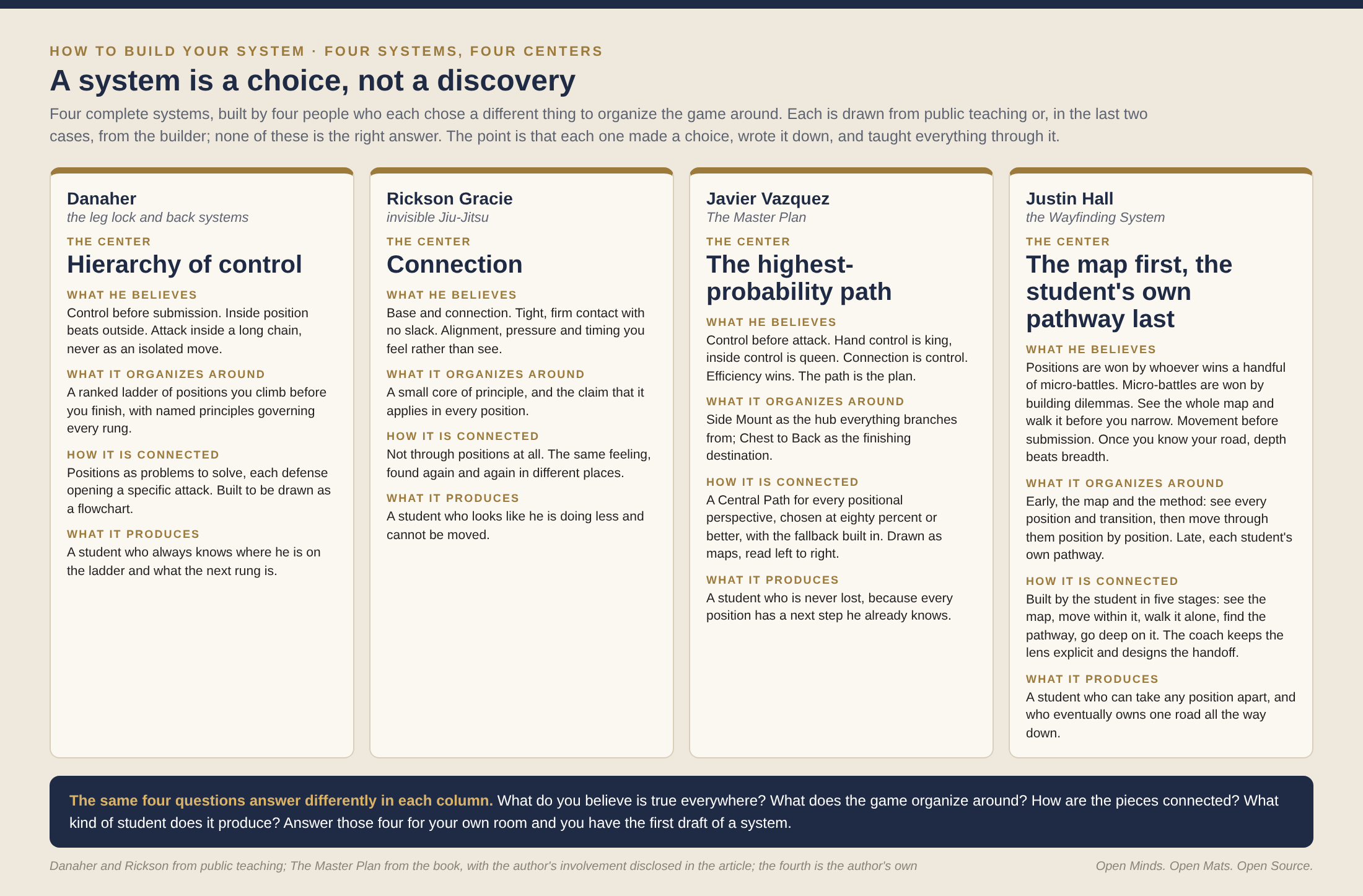
Four complete systems answering the same four questions differently. The disagreement between the columns is the point.
Danaher: hierarchy of control.
The organizing idea is a ranked ladder. Positions are ordered by how much control they give, you climb before you finish, and a layer of named principles governs the climb: control before submission, inside position beats outside position, attack within a long chain rather than as an isolated move. Each position is framed as a problem to solve, designed so that every defense the opponent tries opens a specific attack. It is the most concrete of the four because it is anchored to positions, which is why his students publish it as flowcharts. It was built to be drawn.Rickson Gracie: connection.
At the other end of the abstraction. There is no ladder and no sequence. There is a small core of principle, base and connection, tight contact with no slack, alignment and pressure and timing you feel rather than see, and the claim that the same feeling lives in every position in the art. The game organizes around a quality rather than a place. His student Henry Akins has done the most to teach it publicly, and the difficulty of teaching it is itself instructive: a system built on feel transfers slowly, through hands, and the coach who chooses this center has chosen the hardest one to hand to a room.Javier Vazquez: the highest-probability path.
Full disclosure, as in the earlier pieces: the system is entirely Javi's and I have no hand in it. My involvement is on the business side, helping him bring it to more people, so weigh my admiration accordingly. I include it because it is the one system in this piece whose builder I can ask how he built it, and because his book, The Master Plan, lays the construction bare in a way the others do not. His beliefs are stated as laws: control before attack, hand control is king, inside control is queen, connection is control, efficiency wins, the path is the plan. His center is a position, Side Mount, chosen on stated reasons, the most stable place to apply constant pressure and the hub from which every other position is reachable, with Chest to Back as the finishing destination. His connections are the Central Paths: one for every positional perspective, defined as the highest-probability sequence from first contact to finish, chosen at eighty percent or better, with the fallback built in, and drawn as maps read left to right. The organizing idea is probability. The mechanics underneath are the why; the path is the center.The fourth is mine, and it is built in front of you at the end of this piece, so here is only the shape. I call it the Wayfinding System, because wayfinding is navigating by reading the terrain rather than following directions, and that is what it is built to produce. The territory is the map: every position, every transition, where each one leads. The unit is the micro-battle, the handful of small contested fights inside any position. The beliefs are that positions are won by whoever wins those, that micro-battles are won by building dilemmas, that a student should see the whole map and walk it before narrowing, that movement comes before submission, and that once a student knows his own road, depth beats breadth. The center moves: early it is the map and the method, see the territory and then move through it position by position; later it is each student's own pathway. It is the only one of the four where the coach does not choose the center for the student. He chooses the way the student will find it.
One more difference between the columns, and it is the one that matters most for the reader deciding what to build. Three of these systems tell the student what his game is. Danaher's student climbs the ladder, Javi's fights to side mount and finishes from the back, Rickson's connects. The fourth tells the student how to find out what his game is, and it can do that only because its beliefs sit one level up: they are claims about how positions work and how a person comes to own a game, not about what to do in a particular position. Call the first kind a content system and the second a process system. A content system produces the same game in every student, on purpose. A process system produces a different game in each, on purpose. Neither is better. They are different answers to question two, and a coach should know which one he is choosing.
Four systems, and the same four questions answer differently in each. What do you believe is true everywhere? What does the game organize around? How are the pieces connected? What kind of student does it produce? Answer those for your room and you have the first draft.
The system you run and the system you teach
One decision before any of the questions, and it falls out of the fourth column. The system you run and the system you teach may not be the same thing, and a coach has to know which one he is building before he picks a center.
Every high-level competitor has a system, and it works for exactly one person. That is not a flaw; it is what a personal system is. It was built around one body, one temperament, one set of positions that person happens to reach, refined over a decade of matches, and it is complete. Roger Gracie is the example everyone reaches for, a very small subset of the art, the basic pass, the mount, the cross-collar choke, with the time everyone else spent on breadth spent instead on every small fight inside that narrow road. I do not know the details of what he teaches, so take that as the public picture and not a claim about his room. The point does not depend on him. The system that makes a champion is rarely the system that would make the hundreds of different bodies that pass through an academy over the years better, and the method the champion used to build it is a separate question from the system itself. Danaher, Rickson and Javi built systems meant to be handed to other people: one center, one set of paths, taught to every student the same way. Mine is a teachable system that produces personal ones, which is the distinction the rest of this piece needs.
The reader of this piece is almost always building the second kind, a system for a population rather than for one person. That changes the second question below, because a center chosen for your own game and a center chosen for the hundreds of people who will pass through your academy and are not you can be different positions, different principles, or different kinds of thing altogether. Decide which you are building and write it at the top of the page.
The build: six questions, in order
The build is not a technique project. It is six questions answered on paper, about the Jiu-Jitsu you already teach, in this order, each with a test that tells you whether the answer is real. The first, second and fourth are the three steps from Curriculums and Systems. The third borrows a form from The Master Plan. The fifth is the micro-battle lens. The sixth is the series' standing position on anything built.
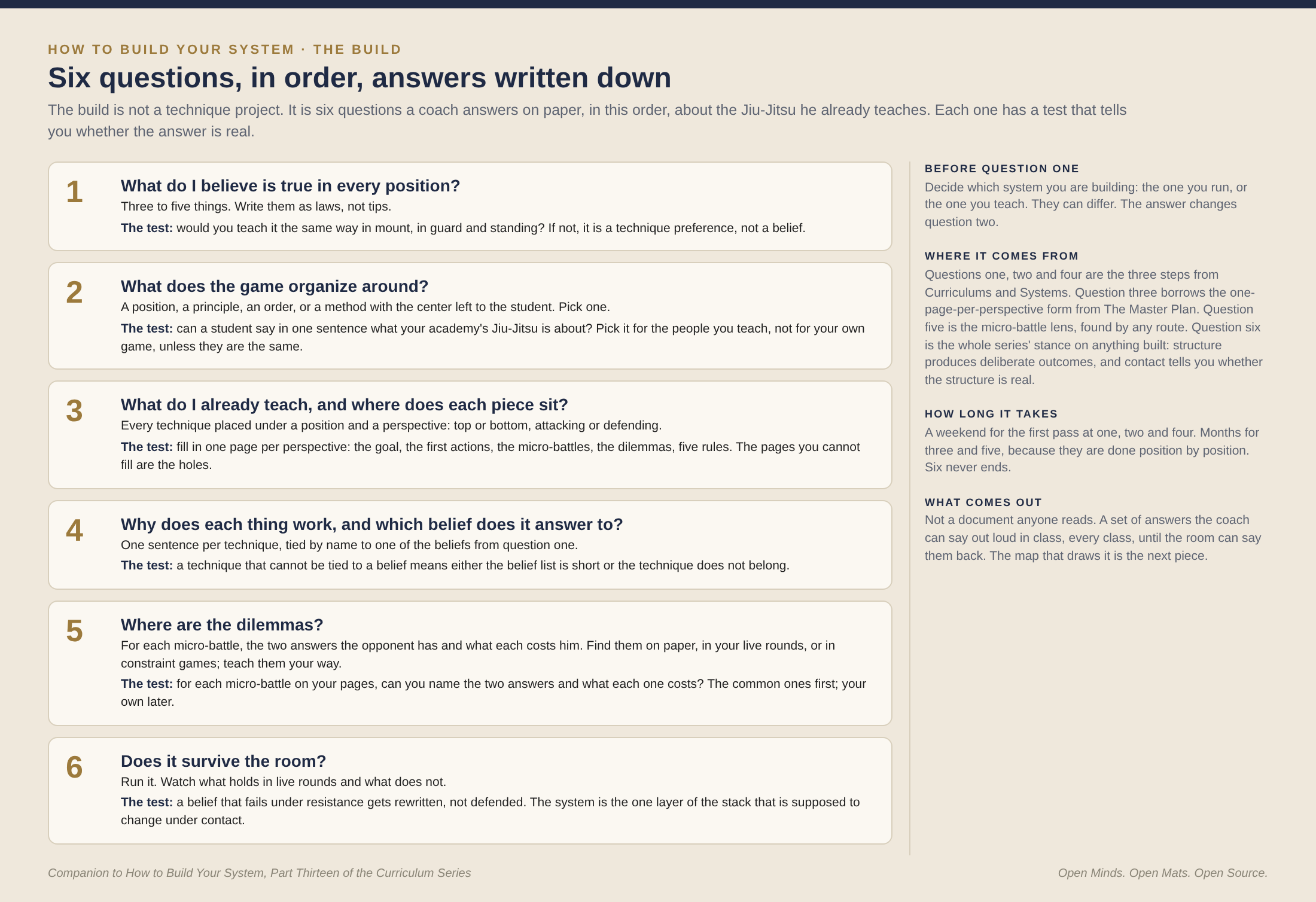
The six questions, each with its test. The right-hand notes say where each comes from and how long it takes.
One. What do I believe is true in every position?
Three to five things. Not twenty; you will not teach through twenty, and a list that long is a list of techniques wearing a disguise. Write them as laws, the way Javi writes "hand control is king," not as tips. If the sentence has "usually" or "try to" in it, it is not finished.
The test is simple and it is brutal. Would you teach this the same way in mount, in guard, and standing? If yes, it is a belief. If it is true in side mount and quietly stops being true in closed guard, it is a technique preference, and it goes on a different list. Expect a first draft to fail this test on three of five lines, which is fine; that is what the test is for. Two real beliefs is a good first pass.
Where to find them if the page stays blank: listen to yourself coach for a week. The thing you say in every class, to every student, in every position, is a belief whether or not you have ever called it one. "Get your hands inside." "Don't give them your back for free." "Connect before you move." Write down what you already say. Then ask whether you mean it everywhere.
Two. What does the game organize around?
A system has a center, and the four systems above show the kinds of thing a center can be. A position: Javi's Side Mount, everything reachable from it, every pass aimed at it. A principle: Rickson's connection, found again in every position. An order: Danaher's ladder, with the next rung always known. Or a method, with the center itself left to emerge: mine, where the way of attacking any position is the center early, and the student's own pathway is the center late. Pick one. A game that organizes around two things organizes around neither.
The test: can a student say in one sentence what your academy's Jiu-Jitsu is about? Not what you teach; what it is about. "We fight to side mount and finish from the back." "Everything here is connection." "We learn to take any position apart." If your blue belts cannot produce a sentence like that, there is no center yet, there is only a schedule.
And pick it for the people you teach. This is where the decision from the previous section bites. The center of your own game is the right center for your room only if your room is full of people like you, and it never is. Javi chose Side Mount for his students because it is the most stable, most reachable hub for the widest range of bodies, not because it is the most exciting position to him. A coach who loves the guard and builds the academy's system around pulling it has built a system for himself and asked every student who walks through the door for the next ten years to live in it.
Three. What do I already teach, and where does each piece sit?
Now the inventory, and this is the step that takes months rather than a weekend, because it is done position by position. Take every technique you teach and place it under a position and a perspective: top or bottom, attacking or defending. Closed guard bottom, attacking. Side mount top, controlling. Mount bottom, escaping. If you have never laid your own material out this way, the first thing the layout shows is the holes: four pages of side mount top and half a page of side mount bottom, a mount chapter with no escapes, a turtle that exists only as a thing you do to other people.
The practical tool here is borrowed, with credit, from The Master Plan, because it is the best version of it I have seen. Javi's book gives every positional perspective the same one-page form: the goal of the perspective in the system, the first actions, which he calls default behaviors, the central path step by step, what you do to make the opponent act, and five or six golden rules. Eighteen chapters, one form. You do not need his content; you need his discipline. One page per perspective, same headings on every page, and the pages you cannot fill are the places your system does not exist yet. For this piece the headings are: the goal, the first actions, the micro-battles, the dilemmas, five rules. The middle two are filled in at question five.
The test is the blank page. If you sit down to write side mount bottom and have nothing to say beyond "shrimp and recover guard," you have found a hole in the system. You have almost certainly also found a position you have not been teaching, because a coach with nothing to say about a position tends not to put it on the schedule, so the blank page is also the next few weeks of lesson plans. The inventory is not the system. It is where the system shows you what it is missing.
Four. Why does each thing work, and which belief does it answer to?
One sentence per technique, tied by name to one of the beliefs from question one. The knee slide works because it keeps inside position on the near leg. The cross-face works because it controls the turn. You break posture before you attack from closed guard because good posture is the defense to every submission from there; against intact posture there is nothing to attack, so breaking it is what makes an attack possible at all. Each of those is a mechanical reason, and each one answers to a belief, inside position, control the turn, control before attack, without simply restating it. That distinction matters: "because control before submission" is not a why, it is the belief said again. The why is what the technique does to the body that makes the belief true in that position. This is the cheapest upgrade in the whole build, the one Curriculums and Systems called making the connections out loud, and it is where the system becomes audible in the room: the coach who says the belief by name every time he teaches a technique that depends on it is building a system in front of his students, and the one who teaches the technique without the sentence is building a curriculum.
The test cuts both ways. A technique that cannot be tied to a belief means one of two things. Either the belief list from question one is short, and the technique is telling you what you actually believe but did not write down, or the technique does not belong in your system and has been living in your curriculum out of habit. Both are useful. The second one is how a coach discovers that a quarter of what he teaches is there because someone showed it to him in 2009.
Five. Where are the dilemmas?
This is the step the first half of the series only implied, in the systems piece, through Danaher and the idea of answers you did not drill, and it is the sharpest tool a system has. A dilemma is a principle that forces a winning outcome no matter what the opponent chooses. Two answers, both bad. Danaher's systems are built on them, and so, once you look, is every system that holds up against a resisting person.
Here is the sequence for finding them, and it is the sequence I would teach a coach in this order, because each step depends on the one before. First, learn to see the micro-battles. A beginner in side mount sees a pile of weight. A student who has played the position under constraints for a few months sees the wrist, the turn, the underhook, the knee line, as separate fights with separate outcomes. That seeing is the first skill, and it only comes from being put into the micro-battle over and over. Second, once you can see one, you start losing it to people who have a structure for it and winning it against people who do not, and that is where the dilemma appears: you win the micro-battle on purpose by giving the opponent two bad answers. You cannot build the dilemma before you can see the battle it lives in, which is why you cannot hand a white belt a dilemma and have it mean anything. Play the position, find the micro-battles, win them by building dilemmas. The micro-battles and the dilemmas feel like one and the same thing because the way you win a micro-battle is by creating a dilemma.
The clearest written example I know is Javi's, from side mount top. Pin the near wrist to the mat. The far arm has to reach across to help, and when it does the body turns. If they turn in, you ride to what he calls Quarter Side Mount Front, with guard recovery blocked and the arms crossed for a choke. If they turn away, you follow to Quarter Side Mount Rear, and the back is exposed. Same micro-battle, the turn, converted into a dilemma: every direction they choose has a trap waiting, and the pin is what makes them choose. He has a broader name for the same idea from the bottom, Common Goal Cooperation: attack with a real threat, a guillotine or a kimura from guard, so that the opponent's best defense, rolling or turning, hands you the position you wanted all along. In his words, you present problems that offer only two outcomes, both of which push the opponent down your path.
There are two kinds of finding, and they belong to different stages of a student. The first is finding the dilemmas that already exist in a position, the ones true for every body, the way the wrist pin forces a turn whoever is underneath. Sean Applegate, whose approach the systems piece mentioned, described to me how he does this with his people: he picks one position, lays out its points of control and the pathways out of it, and has students explore until they find the forced choices for themselves, working on one position for hours. I have not been in the room for it, so take that as his description rather than my observation, but it is exactly the convergent form of this step: the dilemmas are there, the students are led to them. The second kind is generating dilemmas that fit a particular body and a particular game, which is what a student does once he has a road of his own, and it is the divergent form. The common ones first. Your own later.
Two separate jobs here, and the six questions only require the first. Finding the dilemmas in your own game is universal, and there are three routes to it; use whichever fits how you work. Sit with a position and do it on paper: take each micro-battle from your pages, write down the two answers the opponent has, and write what each one costs him. Or watch your own live rounds and sort the small fights your students win on structure from the ones they win on size or speed; the second list is where the dilemmas are missing. Or run constraint games that narrow a position to one fight and let the room surface them. Teaching the dilemmas is where methods differ, and the series has already made the case that the choice is yours. A direct teacher shows them explicitly, the way everyone teaches the triangle, armbar and omoplata chain, and his students own exactly the ones he shows them, which is a real and respectable system. A discovery teacher builds the game that makes students find them, and his students own the ones they found plus the habit of finding more. That second part is my belief and not a law. Either way, the test for this question is on the pages from question three: for each micro-battle you wrote down, can you name the two answers the opponent has and what each one costs him? Where you can, the system is real there. Where you cannot, you have a technique you win on speed.
Six. Does it survive the room?
Run it. Say the beliefs out loud in class, teach through the center, tie every technique to its reason, put the room into the micro-battles, and watch what holds in live rounds and what does not. A belief that fails under resistance is not defended; it is rewritten. This is the one layer of the whole thing that is supposed to keep changing. A curriculum is a structure, and it should hold still long enough for students to move through it. A lesson plan is a structure, and it should hold for the hour. A system is not a structure. It is tied to what you believe, and what you believe changes as your understanding does, so the system should evolve with you for as long as you are teaching. The room is where that happens, because the room is the only honest test of a belief.
Javi says the same thing in the introduction to his book, in his own words: this is my Master Plan, but once you make it yours, you become part of the legacy that carries it forward. The most complete system in this piece is handed to the reader with the expectation that the reader will change it. Anything built from these six questions should be held the same way. It is finished the day you stop teaching.
Mine, through the six questions
What follows is my own system answered through the questions above, built in front of you rather than presented as the answer. It is a teaching system, not my personal game, though my game is where it ends up, and I will say so when we get there. I call it the Wayfinding System. In its current form it is recent: I have been circling it for years and it only became one thing when I was forced to say it out loud for this piece. Treat it as a worked example of the method, not as a recommendation.
One, the beliefs.
Five laws. Each is true in mount, in guard and standing, and I would teach each the same way in all three.· Positions are won by whoever wins a handful of micro-battles inside them.
· Micro-battles are won by building dilemmas.
· A student should see the whole map and walk it before he narrows. He cannot choose a road he has not been down.
· Movement before submission. A student should learn to get from any position to any other against resistance, then to hold what he reaches, then to get out, and only then to finish. That is the order the game happens in, so it is the order to learn it in.
· Once he knows his road, depth beats breadth.
Two of those need their reasons, because the reasons are most of the system.
The map first, because the map is what puts a student ahead. Picture two people who started the same month and have trained the same hours. One learned techniques as they came, a sweep this week, a choke the next, good ones, in no particular order. The other learned the map: where every position leads, what to establish on arrival, what establishing it opens for him and what it closes for the other person. Put them in the same scramble. The first is asking what he can do from here. The second already knows where he wants to be three moves from now and is working toward it. That is what the map buys: not more technique, but less time spent finding out where you are. It is the first thing the system builds because everything after it depends on the student knowing where he is.
Dilemmas found rather than taught, because dilemmas cannot be taught. Everyone knows the triangle, armbar and omoplata dilemma from closed guard, and a coach can teach it directly in an afternoon. The problem is that it is one dilemma, and a student taught that way knows exactly the dilemmas he has been shown and no others. The micro-battles inside the positions are, for practical purposes, infinite, and so are the forced choices inside them; no instructor alive can teach them all, and no instructor can know in advance which ones a given student will need. What a coach can teach is how to find them. That is what the constraint games do, from the first month, without anyone announcing it: a white belt given a narrow goal against a resisting partner who keeps winning the same small fight will, sooner or later, give that partner two bad answers, because it is the only way to score. He is building a dilemma. He does not know the word. By the time he does, he has been doing it for years, and when he hits a wall in competition at purple belt he does not wait for someone to show him the answer. He knows the drill that finds it.
The fourth is a principle, not a schedule. Nobody stays two years for transitions alone. So it shows up in two practical ways: as weighting, more transition days than submission days inside a block, and as the constraints on those days, no submissions allowed, move through the positions, micro-battle the transition itself. The student meets submissions from the first month. He meets them as the thing you do once you have arrived, not as the reason to arrive.
Two, the center.
This is where mine differs from the other three, and I want to be exact about it. The center is not a position and not a principle. Early, it is the map and the method: the student learns to see the whole territory, every position and transition and where each one leads, and then moves through it position by position, the same way in every time. Later, the center is the student's own pathway, chosen by him once he can walk the map without me. So the coach does not choose the center for the student. He chooses the way the student will find it, and he designs the moment of handing over. That is what makes it a process system rather than a content system, and it is also where it has to be watched: the beliefs have to stay claims about Jiu-Jitsu, side mount is decided by the wrist, the turn, the underhook and the knee line, delivered by discovery, and never slide into claims about teaching. The moment "explore the position" becomes the belief instead of the method, this stops being a system and becomes a delivery style. The sentence a student should be able to say about the academy is: we learn to see the map and walk all of it, and then each of us goes deep on one road.Three, the inventory.
Positional, by design, because the system is built on the map and the curriculum has to be the map taught in order. Every position gets the same treatment: top and bottom, and inside each the same four jobs: transitions, control and stabilization, escapes, submissions, weighted toward movement because the fourth belief says so and a real room cannot be taught it any other way. The one-page form is filled in per position and the micro-battles column is the one I care most about, because the exploration fills it in for me. This is the same structure as the positional curriculum the later pieces will build, which is not a coincidence; the system and the curriculum were designed to fit.Four, the why.
Every technique is taught as the answer to a micro-battle a student has already lost. That is the whole of the connection step in this system, and it is why the hour is built the way the last two pieces built it: discovery first, so the student meets the battle; instruction after, tied by name to the problem each student already felt. The sentence is: this is how you win the fight you were just losing. And every technique also gets placed on the map out loud, where it starts, where it ends, what it connects to, because a technique the student cannot locate on the map is a technique he will not find under pressure.Five, the dilemmas, and this is where the system has stages, which is the part that is new and the part people will argue with. There are five, and they are all about the map.
First, see the map. Before anything is drilled seriously, the student can picture the whole territory: every major position, every transition, where each leads, the order of operations, where he is in space at any moment. This is a mind map taught on purpose, the same thing I built for an eight-year-old on one page, done for an adult room. It is the one piece of the hierarchy idea I keep: a student should always know where he is and what is above and below him.
Second, move within the map. The positional curriculum, each position in turn, and inside each the four jobs. Every job is taught through the blend the first half of this series laid out: self-exploration first, constraint games, direct instruction tied to what was just felt, positional drilling, free rounds. This is where the micro-battles get found, position by position, and where the basic dilemmas, the ones true for every body, get built. It is the same for kids and adults, with the intensity turned up for adults. It takes years and it is supposed to.
Third, walk the map alone. At some point the student no longer needs me to tell him where he is or where to go. Put him in any position and he can take it apart: find its battles, build the common dilemmas, and move to the next place on purpose. This is the test that the first two stages worked, and it is also the test for the handoff, because a student who cannot yet walk the map cannot choose a road through it.
Fourth, find the pathway. Having walked all of it, the student can see where his game lives: which positions he gets to, which battles he wins, what his body and his temperament are built for. Somewhere around purple belt, usually. This has to be a designed moment, a conversation the coach starts, not something that happens to the lucky ones, and it is the single place in the system where the coach's judgment of a student matters most.
Fifth, go deep on the road. The same drills and the same methods, aimed at a much narrower target: the micro-battles of his specific pathway, and the dilemmas that fit his body and his game, solved years ahead of when he will need them. The exploration gets more micro, not less; the constraints get tighter; the positions get fewer. This is where a student stops being broad and starts being dangerous.
My own game is what the fifth stage produced in me, late and without a coach designing it. From standing, a pass, usually a long pass because of my length, to side mount. From side mount to mount, sometimes through knee on belly. Stop the roll. Hand in the collar. Then fight the micro-battles until the collar choke is there. It is, obviously, Roger's game plan, and I want to be clear about the difference: it is the same road at nowhere near the same level, because I did not recognize until much later in my own training that the way to get good at a short road was not more techniques around it but every micro-battle inside it, solved in advance. He appears to have understood that from the start. I am happy running it five times in a row on the same person, and I will keep running it until someone figures out how to stop it and forces me to do something else. Until then it is the game plan, every time. Another student's road will be different. The five stages are identical, and that is the system.
Six, the room.
The honest risk, and I would rather name it than have it found. The first two stages, run by a coach who does not hold the beliefs, are just a positional curriculum with games in it. What makes it a system rather than a curriculum is that the coach teaches the map and the micro-battle lens on purpose, every class, says it out loud, tests for the third stage before he offers the fourth, and treats the handoff as a designed moment with a conversation attached. If those things are not explicit, this is exactly what You Have Classes, Not a Curriculum warned about, one layer up. So the load-bearing parts are the beliefs, the map, and the handoff, not the drills. The drills are the easy part.Now you
You have seen the six questions answered four different ways and watched one system get built through them in front of you. Your answers will not look like mine, and they should not. Nothing below requires you to teach the way I teach. A coach who runs direct instruction and always will can answer all six and end up with a system as complete as any in this piece; two of the four above were built that way. Here is how to do it, in the order the questions run, with a rough clock on each.
This weekend, questions one and two.
One page. Write three to five things you believe are true in every position, as laws. Run each one against mount, guard and standing and cross out the ones that fail. Then write one sentence that says what your academy's Jiu-Jitsu is about, and decide whether you are building a system for yourself or for the room. Put that decision at the top of the page. This is an hour or two of honest work and everything else depends on it.The next month, question three.
One position a week. For each one, two pages, top and bottom, same headings on every page: the goal, the first actions, the micro-battles, the dilemmas, five rules. Fill in what you can. Leave the micro-battles and dilemmas blank where you do not know them yet; that is what question five is for. The pages you cannot fill at all are your holes, and they are also what to teach next.Every class from now on, question four. When you teach a technique, say which belief it answers to, out loud, by name, and say where it sits on the map. One sentence. If you cannot find the belief, write the technique down and look at it later: either your list is short or the technique does not belong.
The season, question five.
Take the positions from your pages and find the dilemmas inside them, by whichever route fits how you teach: on paper, by writing the opponent's two answers for each micro-battle; in your live rounds, by sorting what your students win on structure from what they win on size; or in constraint games, if that is how your room works. Then teach them the way you teach everything else. Write the micro-battles and the dilemmas onto the pages as they show up. The common ones come first. The specific ones come later. This is the slowest step and it never fully ends.Always, question six.
Watch the live rounds. When a belief fails under resistance, change the belief, not the story about why it should have worked. Reread your one page every few months. It will be different, and that is the system doing its job.Do that and in a year you will have what the first half of this series described and almost no academy has: a short set of things you believe, a center the game organizes around, and every technique you teach connected to both, said out loud so often that your students can say it back. It will not be mine and it will not be Javi's. It will be yours, and that is the only kind that holds.
What comes next
The system is in your head and on your pages. The next piece, How to Build Your Map, is how it gets drawn so a student can carry it: sizing the map to its purpose, the transfer problem of getting it into a student one node at a time, and the actual drawing. The map is the artifact. What you built here is the thing it is a drawing of.
Open Minds. Open Mats. Open Source.