How to Deliver a Lesson
By OSJJ
Open Source Jiu-Jitsu
THE CURRICULUM SERIES · PART TWELVE
How to Deliver a Lesson
The plan is the container. This is what the coach does inside it: which method runs each block, where the dials sit, when to talk and when to be quiet, and how a position gets into a room two different ways.
Justin Hall / Co-Founder, Open Source Jiu-Jitsu
The last piece built a page. This piece opens it up. How to Build a Lesson Plan carved the hour into blocks, gave each block its minutes and its job, and left a note in each one saying how it would be delivered. This is the piece that fills in the note. What does the coach actually do in the technical block? Which of the nine methods is running in the drilling? Where are the dials set, when do they move, and what is the coach looking at while the room works?
A recommendation before starting. This piece leans on The Teaching Methodologies more than any other in the series; it names the nine methods by name and assumes you know what each one is. If you have not read it, or it has been a while, read it first, or at least keep it open. Practice Design, which covers the seven dials, is the other one worth having fresh. You will get far more out of what follows with both in mind.
Nothing here is new. Every tool in this piece was introduced in the first half of the series: the nine methods from The Teaching Methodologies, arranged on a line from the coach supplying the answer to the student discovering it; the seven dials from Practice Design, which set how a single technique is practiced; the argument from Blending Teaching Methods that varying the how inside an hour reaches more of the room; and the four questions from The Lesson that a coach should be able to answer about any hour he teaches. This is where those tools go on the mat, in order, inside a real plan. It is the payoff of the whole delivery thread, which is why it is long.
One boundary, the same one the whole series holds. Delivery is a decision, not a doctrine. The hour below runs four methods in a particular order because that is what we run and what we recommend when the goal is to reach the whole room. A coach who understands the tools and chooses a different order, or one method for the whole hour, is not doing anything wrong. The second worked example in this piece runs a class on the same position the more common way, three techniques, each taught then drilled, then live, and runs it well. The target of this piece is the coach who has never seen the decision, not the one who made it. And both hours here are adult classes. Delivering a kids class is a different problem, how much you expose them to, how much you say, how you frame it, and it gets its own treatment later rather than a paragraph here.
The delivery decision, block by block
Every block in a plan carries three delivery choices, whether or not anyone made them on purpose.
The method.
Which of the nine is running. Direct instruction, guided discovery, a constraint game, reciprocal teaching, live rounds. A block with no method named is a block being taught however the coach feels that day, which usually means the method he learned under.The dials.
How the practice inside the block is shaped. Whole technique or a part of it. The same situation every rep or a changing one. How much resistance. How often the coach corrects. The dials have settings that fit a beginner and settings a student graduates to, and the mistake Practice Design named is never moving them.The coach's attention.
What the coach is doing while the block runs. This one does not go on the plan, because it is the live part, but it is the choice that separates a decent hour from a great one, and most of this piece is about it. In some blocks the coach's job is to talk. In more of them than coaches expect, the job is to watch and write things down.The plan carries the first two. The coach carries the third into the room. Here is what all three look like inside a real hour.
Hour A: the positional plan, opened up
This is the plan from the gallery in the last piece: an advanced positional curriculum, side mount block, week one, class two, the job is transitions, the transition is side mount to mount. Five blocks, sixty minutes, no separate warm-up. The hour runs wide to narrow and then reopens: the problem is posed, the room explores it, constraints narrow the exploration, instruction arrives with the answer, and the last fifteen minutes are live. What follows is each block with its method, its dials, and what the coach is doing. The words in italics are close to what we actually say.
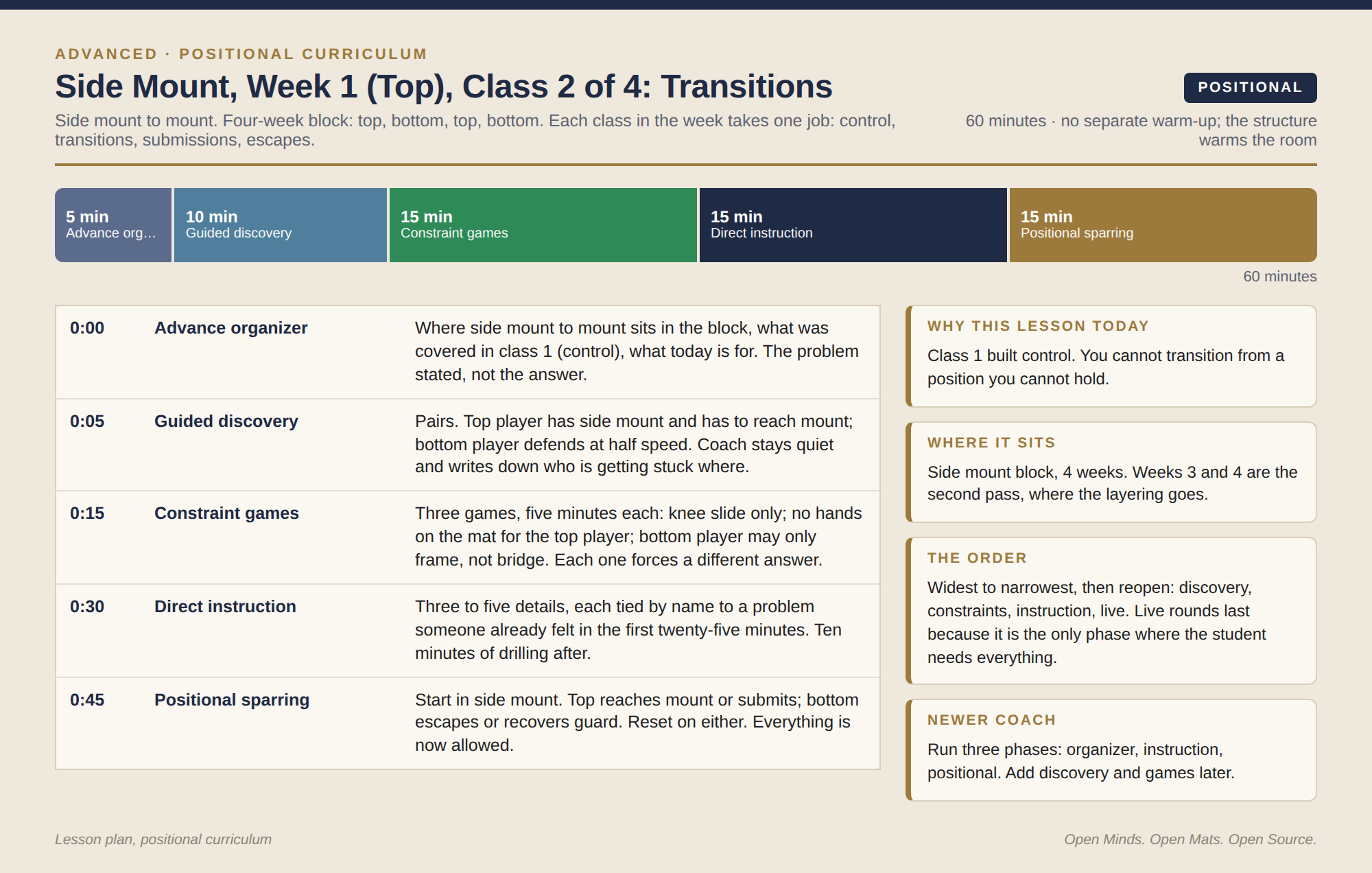
The plan being delivered. The right-hand column is what the plan says; the sections below are what the coach does with it.
Block 1. Frame the problem. Five minutes.
Method:
the advance organizer, which is conceptual direct instruction with a question inside it. You tell the room what today is about and why it matters before anyone touches the mat, so the material that follows has somewhere to land. Delivered as a question rather than a statement, it also gets the room building the map instead of receiving it.Dials:
none yet. Nobody is practicing anything.The coach:
frames and asks, and does not teach. Gather the room. Name the day as a transition day. Then ask instead of telling.Today is a transition day. If we are on top in side mount, that is a good spot, but it is not the best spot. So where would we rather be? Who can tell me the better positions we could move to from here?
Let them answer: mount, back, knee on belly. Steer the conversation to side mount as a hub with other positions above it, and to the fact that today picks one road. Thirty seconds on why mount, and be accurate about it, because the room will know if you are not. Side mount is usually the harder position to escape, and the control is roughly equal. The reason to move is attacking options. From mount you can attack both sides, the submission menu is larger, and in a self-defense context it is a far better position to strike from and a far harder one to defend. So the honest frame is a choice: if you are prioritizing stabilization, stay; if you are prioritizing finishing, mount gives you more. Today we are choosing finishing. Then move. The temptation in this block is to start teaching, and the discipline is not to. Five minutes, the problem is planted, nothing has been solved.
Block 2. Guided discovery. Ten minutes.
Method:
guided discovery. The coach does not give the answer. Students are put in the position with the goal and guided with questions while they find the pathways themselves.This block is also the warm-up.
That is by design, not by accident. Ten minutes of light resistance, playing with the position, flowing through it, trying pathways to see what works and what does not, is exactly what a warm-up is supposed to do to a body, and it does it with the day's transition instead of with laps. By the end of it nobody is cold and everybody has already met the problem. This is why the plan has no separate warm-up block.Dials:
whole task, not parts. Random, in the sense that every rep is different because nobody has been told what to do. Light, honest resistance from the bottom player. No corrective feedback at all.The coach:
is quiet, and is doing the most important thing a coach does in the whole hour. Pair them up, one on top in side mount, one on bottom giving light and honest resistance.Top player, your only job for the next several minutes is to get to mount. Bottom player, do not let them, but keep it honest. Top player, try every path you can think of. Do not force one way. Explore. Notice what opens the door and what slams it shut.
Circulate. Do not correct technique. Ask questions that point attention: what did the bottom player give you right before you got there, where did you keep getting stuck, what happened to their hips when you came across. And while you are not talking, watch each person and write down exactly where they struggle. Bobby keeps getting scooped under the knee. Sarah never kills the frame. Mike floats when he lands. You are not fixing any of it yet. You are building a list, and every item on it gets used in block four.
Freeze. Some of you found something that worked. Some of you kept hitting a wall in the same spot. Hold onto both. We are about to work exactly those problems.
Block 3. Three constraint games. Fifteen minutes.
Method:
the constraints-led approach, run as games. The transition is broken into three checkpoints and each becomes a small game with one win condition. The checkpoints are the places the room got stuck in block two, so the games work the real problems.Dials:
part task, one checkpoint per game. Resistance tuned pair by pair so the attacker succeeds about half the time. Fast resets. No correction during the game.The coach:
sets the game and then mostly stops talking. This is the hardest habit for a coach raised on direct instruction, and it is the whole method. The constraint is the teacher; correcting mid-game short-circuits the discovery it exists to produce. What the coach does instead is run the difficulty: watch each pair, and when the attacker is scoring every three seconds give the defender something, when nobody is scoring take something away. The only talking is to reset, to retune, or to point attention with a question.A constraint game is built from three levers, and once a coach holds them he can design one for any position in the gym. The figure below has them, with the three games for today.
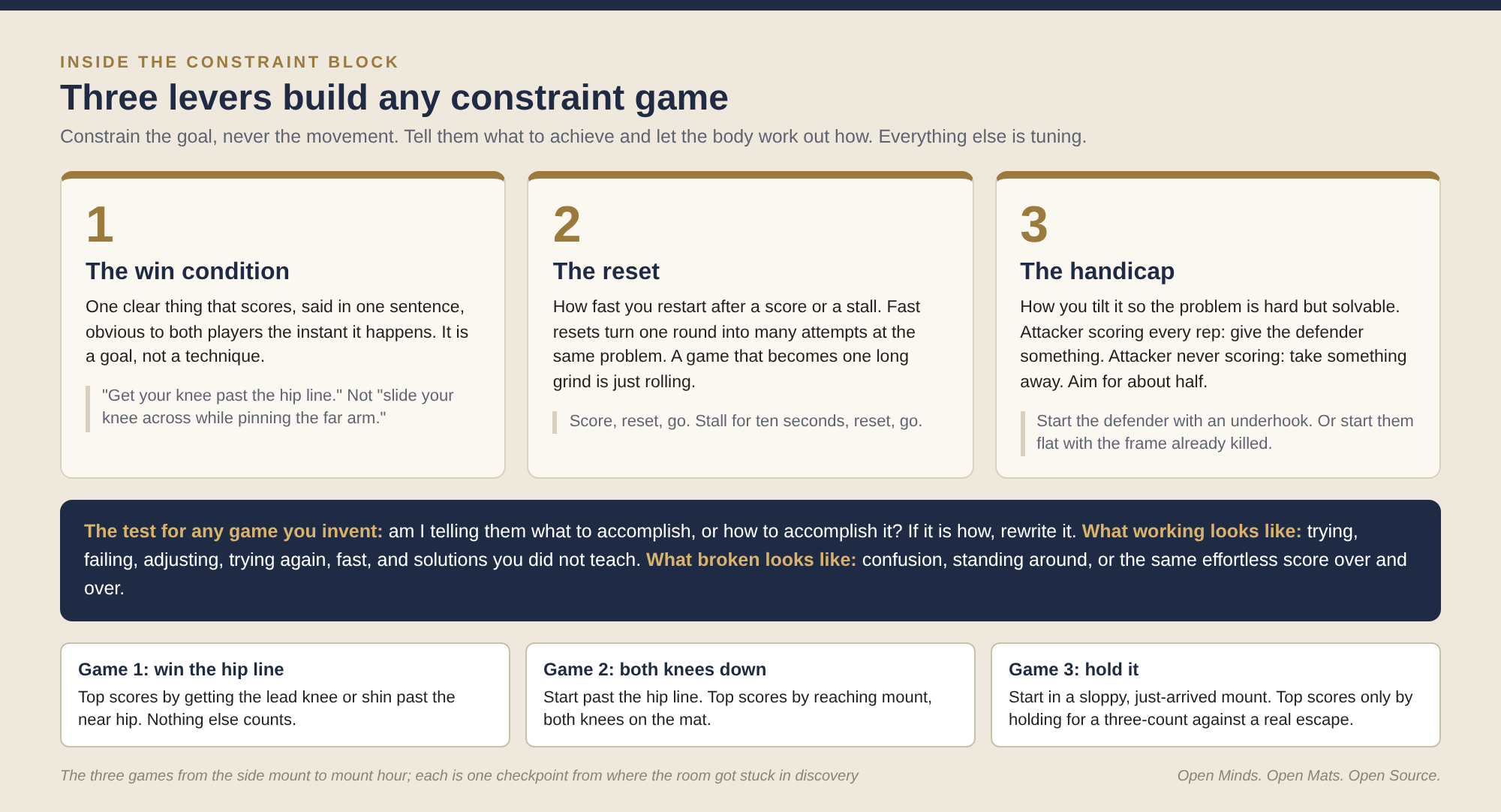
The three levers and the three games. The rule above all others: constrain the goal, never the movement. The quick test for any game you invent is whether you are telling them what to accomplish or how to accomplish it.
Run each game for about five minutes. How you know it is working: people trying things, failing, adjusting and trying again, fast, and solutions appearing that you did not teach and sometimes would not have. How you know it is not: confusion, standing around, or the same effortless score over and over, which means the win condition or the handicap needs fixing. A working game looks like productive struggle. A broken one looks like frustration or boredom.
You just fought for the three hard parts of this transition on your own. Now let me show you the cleanest way I know to do each one.
Block 4. Teach, then drill. Fifteen minutes.
Method:
direct instruction. Now the clean, detailed version: the knee-slide transition, step by step, with the small details nobody discovers on their own. Three to five minutes of teaching, no longer, then about ten of cooperative drilling.Dials:
three to five details, not ten. Blocked practice, the same version every rep. Cooperative at first, then a quarter resistance for the last few minutes. Frequent feedback: this is the one block in the hour where the coach corrects constantly, because the research on feedback says frequent correction helps while the skill is being acquired and hurts retention if it never stops, and the drilling block is where acquisition happens.The coach:
teaches the room, and then teaches each person. This is where the whole structure pays off. The decent coach shows the technique to the room. The great coach shows it to each person, using the list from blocks two and three. Every detail is tied, out loud and by name, to a problem a specific student already felt.Bobby, remember in the games when you kept getting scooped, you would get your foot toward the mat and he would slide right back under it? That is exactly why we switch the hips like this. Watch.
Sarah, you were fighting that frame the whole time and never getting past it. This is the detail that kills it before you ever try to move.
The generic version teaches a move. This version turns each detail into the answer to a question the student was already asking, because he spent twenty-five minutes failing at exactly that spot. A solution to a problem you own sticks. A solution to a problem you never felt washes off. The earlier blocks were not warm-up and exploration; they were generating the questions. This block answers them, one student at a time. It only works if you actually watched, which is why the quiet cataloging in blocks two and three is not optional. Great coaching is mostly great noticing, done early and spent later.
Teach the details that fix what you saw: how to kill the near-side frame before moving, where the crossing knee points, how to trap the far arm so they cannot recompose, how to land heavy and establish rather than float and get bucked. Then drill. Walk the pairs and correct freely; this is the block for it.
Block 5. Positional sparring. Fifteen minutes.
Method:
game-based, live. One position, one goal, full resistance, short rounds.Dials:
whole task. Full resistance. Random, because the opponent decides. Feedback after the round, not during it; the student needs to find out what holds up without a voice in his ear.The coach:
sets the start and the reset, then watches what survived. Top starts in side mount, the only objective is to reach and hold mount. Bottom defends fully. Reset on success or a clear stall.There are two ways to run the block, and both work.
Set partners.
Pairs stay together and switch top and bottom, either on a clock (two minutes each side) or on the result (whoever wins the round takes the other side). Rotate partners every few minutes so nobody spends the whole block on one body. Simple to run, easy to keep honest, and the right choice when the room is new to positional work.Stations.
Pick a number of stations the mat can hold; twenty people on the mat is about four. One person starts on the bottom at each station and everyone else lines up along the wall. The front of the line steps out, takes the top, and goes. Whoever wins stays in; whoever loses jumps out and goes to the back of the line. One rule has to be set before the block starts: which side the winner keeps. It follows from the day. Today the job is the top player reaching mount, so the winner holds the top, and the next person off the wall comes in on the bottom and has to earn it; if the bottom player wins, he takes the top and the person he beat goes to the line. On an escape day it runs the other way, the winner keeps the bottom. Decide it from what you taught, say it once, and the block runs itself. A person who wins three in a row jumps out anyway, because at that point the line is not learning anything from him and he is not learning anything from the line. Three things come with this version. Much more variability in who you are working with, which is the dial Practice Design said matters most once the basics are in. Pace: the block never stops moving. And recovery. Fifteen minutes of straight rounds with one partner means the last five are at whatever pace is left, which is not the pace the block was for. The line is rest, so every round is fought at something close to full intensity, which is the point of going live. That also makes the number of stations a decision rather than a default. Fewer stations and a longer line give more recovery, which suits a newer room; more stations and a shorter line give less, which is what a room of experienced players can handle and wants. Set it from who is on the mat that day. It is harder to run cleanly and it needs a coach who can keep the lines honest, so it is the version to grow into rather than start with.Either way, the goal and the reset are the same; only the traffic changes.
This is the whole day in one drill. You have what you discovered on your own, what you solved in the games, and the technique I just showed you. Use whatever actually works for you. Side mount to mount. Go.
Every student now has several on-ramps to the same transition: the path he found himself, the pieces he earned in the games, and the clean technique he was shown. Here he finds out which ones hold against someone fighting back. Different students will keep different tools. That is the design working. The coach's job in this block is the fourth question from The Lesson: did it land, and how do you know. Watch which details survive contact and which vanish, and write it on the plan's notes line before you leave the building. That line is what you read first the next time this page comes around.
Why that order, and why it is not the only one
The hour above runs from the widest space to the narrowest and then reopens. Discovery is widest: no answer, every pathway. The constraint games narrow it to one checkpoint at a time. Instruction narrows it to one clean version. Live rounds reopen everything, with a student who now walks in holding all of it. Think of a funnel that reopens. The reason instruction comes fourth and not first is that instruction first collapses the space before the student has explored it; he learns one path and nothing about the territory around it, and when the path fails live he has nowhere to go. The reason live rounds come last is that it is the only block where the student needs everything, and you cannot put it all together until there is an all to put together.
That is the argument for the order. It is not an argument that the other order fails. The common hour, warm up, review, teach, drill, go live, works too, and it works at any level, as long as the coach makes the delivery decisions inside it instead of letting them default.
Two things get said about these orders that are not true, and it is worth putting both to rest. The first is that discovery is for advanced students. It is not. A discovery block fails with beginners when the problem is too big; "pass the guard" is a match, and a white belt cannot explore a match. Make the problem the size of a checkpoint, "get your knee past the hip line," and he can explore it on his first night. The second is that instruct-first is for beginners. It is not either. An instruct-first hour fails with advanced students when the drilling runs at one setting the whole way through. Move the dials and it teaches anyone. Neither order belongs to a level. What decides the order is how well the coach can run the methods in it.
So here is a class on the same position, delivered the other way, and delivered well.
Hour B: a mount day, narrow to wide
A rotating fundamentals hour, run the way a majority of adult classes are run: a warm-up, a short review, then three separate techniques, each one taught and then drilled, then free rounds at the end. Today is a mount day, so the three are the knee slide from side mount to mount, holding mount once you are there, and the americana from mount. Three complete techniques, each shown whole and drilled whole. Five minutes to show, five to drill, three times over. That is the teach-drill cycle, and it is where this hour lives.
One number to hold onto before going further. Five minutes to show a technique, seven if there are a lot of details, and that is the ceiling. We have all seen fifteen, and it is too much; the room stops absorbing somewhere around minute six, and everything after that is the coach enjoying himself. Three details per technique, shown twice at two speeds, then pair them up. The teaching in this hour is short on purpose so the drilling has room.
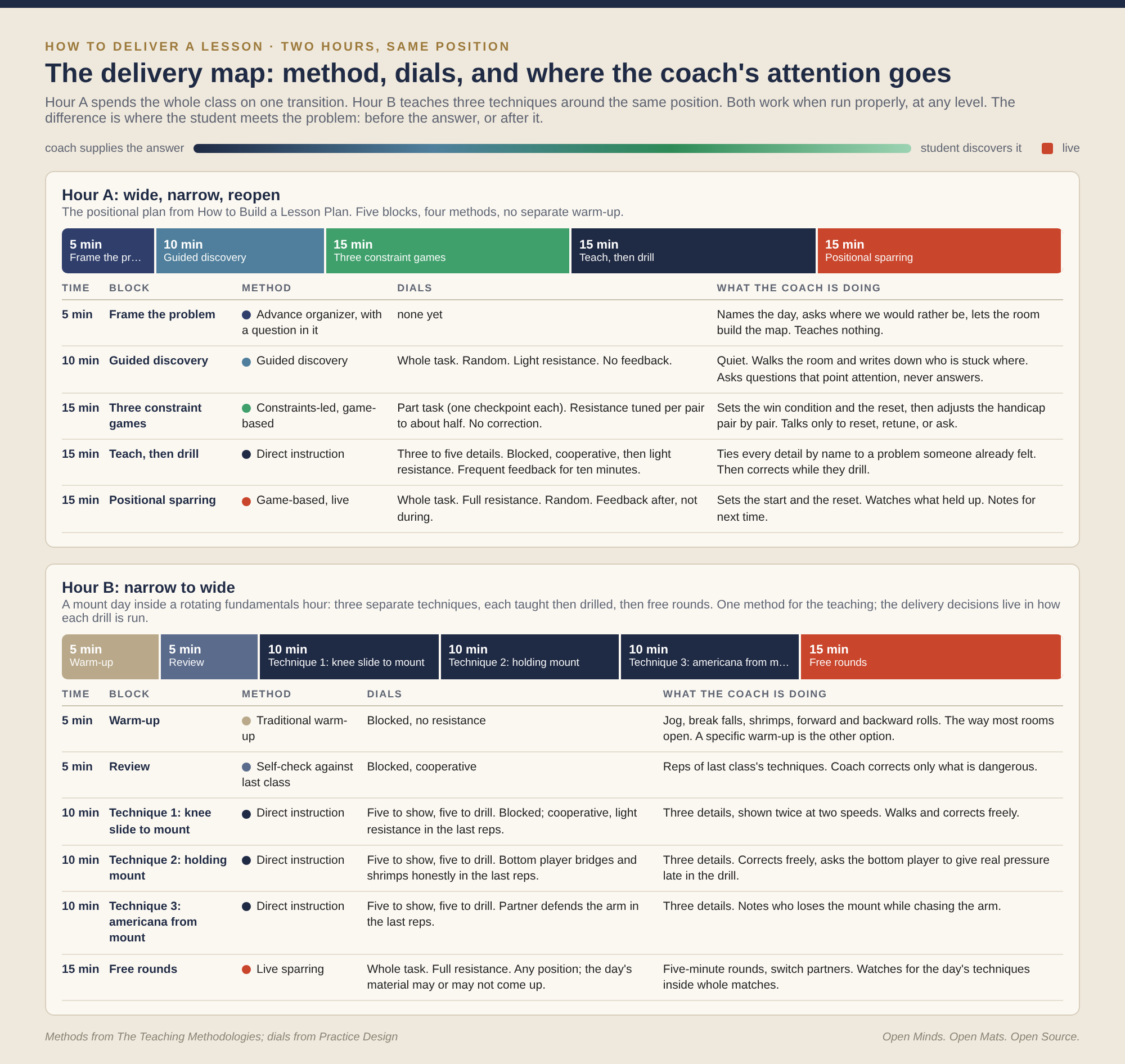
Both hours on one page: the method running each block, the dial settings, and what the coach is doing. Hour A spends the whole hour on one transition and gets its variability from changing the method. Hour B teaches three techniques with one method, so its delivery decisions live inside each drill.
The warm-up is the traditional one, because that is how most of these hours open: a jog around the mat, break falls, shrimps up and down, forward and backward rolls. Five minutes, no resistance, the coach counting or saying nothing. There is nothing wrong with it. The other option, and the one we lean toward when the minutes are tight, is a specific warm-up built from the day's movements, knee slides across a partner's hips, hip switches, a few seconds of hip-heavy mount at a time, which gets the body warm and hands a few extra reps to the technical blocks. Both are a warm-up. Pick one on purpose.
The review is self-check against last class. Five minutes of reps while the coach walks and corrects only what is dangerous. The point is retention, and it does its job without the coach narrating it.
Technique one, the knee slide.
Direct instruction, three details: kill the near frame, point the knee, trap the far arm. Shown twice at two speeds, five minutes. Then five of drilling, blocked and cooperative, the same version every rep, the coach walking the pairs and correcting freely. For the last few reps the bottom player gives a little honest resistance so the top player feels the frame before the live block does it for him.Technique two, holding mount.
Five minutes on staying there once you arrive: hooks or grapevines in, where the weight sits, where the hands post when the bottom player bridges, how to ride the shrimp instead of being moved by it. Then five of drilling, with the bottom player bridging and shrimping honestly in the last reps so the hold is actually tested. The coach corrects freely, and asks the bottom players to give real pressure late in the drill; a stabilization technique drilled against a partner who lies still has not been drilled.Technique three, the americana.
Five minutes on the finish from mount: the grip, the elbow to the mat, the shoulder line. Then five of drilling, with the partner defending the arm in the last reps. The coach is watching for the thing this technique always exposes, which is students losing the mount while chasing the arm, and writing down who does it, because that is exactly what the live block is about to show.The live block is free rounds, because that is what this hour usually ends with. Five-minute rounds from the knees or the feet, switch partners, go. The coach watches for the day's techniques inside whole matches, and how much of them he sees depends mostly on one thing: the gap in skill between the two people rolling. A student rolling with someone well below him can get to mount when he wants to and practice the day's material at will, if he chooses to. Two students close in ability will fight for the position itself, and the closer they are, the less either of them reaches it, because both of them know what is coming and neither wants to be there. The day's techniques get practiced by whoever happened to draw a weaker partner, and barely at all by the pairs that are evenly matched, which are the pairs that would benefit most.
That is the limitation of free sparring in general, and it is worth stating plainly because it is the reason the first half of this series spent so long on constraints and positional work. Left to free rounds, people practice what their body and their partner let them practice. The bigger and stronger student spends his rounds on top and rarely works an escape. The smaller student spends his rounds defending and rarely works a finish. The experienced student reaches his positions and the newer one never does. Free rounds integrate everything a student already has and do very little to put something new into him, which is what they are for and not a flaw. But they are a poor place to test the day's material, and an hour that relies on them for that is testing it whenever it happens to come up, which for a lot of the room is never. The coach who wants the day's techniques tested has a cheap fix available at the end of hour B: start the first two rounds in mount, reset on escape or submission, then open it up for the rest. It costs nothing and it is rarely done.
The delivery decisions in hour B are smaller than hour A's and there are more of them. One method runs the whole technical half, which is why this hour reaches fewer kinds of learner and the blending piece made the case for why that matters. But inside each ten-minute cycle there are choices: how many details, how long the showing runs, whether the last reps of the drill carry any resistance, whether the coach is correcting or watching by the end of it. The default version of this hour, the one this series is written for, teaches the same three techniques with every drill run identically, cooperative from the first rep to the last and the coach talking throughout, and produces the clean-in-drilling, gone-in-rolling problem every coach has seen. The order is not what is wrong with that hour. The drills that never changed are.
What the two hours are trading
Set the two hours next to each other and the differences come down to two, and only one of them has been argued in this series so far.
The first is methods. Hour A runs four, hour B runs one. Blending Teaching Methods made the case: people take in the same material differently, and an hour that presents it several ways reaches more of the room than an hour that presents it one way. That argument stands and there is no need to repeat it here.
The second has not been said yet, and it may be the larger one. Hour A spends the whole class on one technique. Hour B spends the class on three. So the real trade is depth against breadth: a lot of understanding of one thing, or less understanding of several. The student in hour A leaves knowing the side mount to mount transition from the inside, having explored it, failed at it, solved pieces of it, been shown it, and tested it, with the whole hour's attention on that one road. The student in hour B leaves having been shown three things and drilled each for five minutes, with the week's rotation bringing three more next class. More territory covered; less of it owned.
Which is better is a real question and it can be argued both ways. Breadth gives a student a map of the whole game sooner and keeps a rotating curriculum honest about covering it. Depth gives him something that actually survives contact, and it teaches him how to explore a position, which is a skill he keeps after the technique is forgotten. My own belief is the first, depth, and I will say why without pretending it is more than a belief: at the highest levels of this art the best people are not broad, they are extraordinarily deep in a specific game, and a class built around one problem at a time is how a student learns to go deep on anything. But I have run both kinds of hour for years, and the owner who chooses breadth on purpose, because his curriculum is rotating and his room turns over and the map matters more to him than the depth, is not wrong. What this piece asks is only that it be chosen.
Noticing early, spending later
The thread that runs through both hours is the coach's attention, so it is worth pulling out on its own. In most blocks of most hours the coach's job is not to talk. It is to watch, specifically, and to remember what he saw. In hour A that means the list built during discovery and the games: who is stuck where, by name. In hour B it means the same list built in the last reps of each drill, when a little resistance starts exposing what the cooperative reps hid. In both hours the list gets spent in the same two places: in the instruction, where each detail is tied to a person who already felt the problem it solves, and in the notes line after class, where it becomes next week's plan.
This is also the answer to the question of when to talk. Talk in the frame, briefly. Be quiet in discovery and in the games, except to ask. Talk freely in instruction and early drilling; this is the block the research says frequent feedback belongs in. Taper off as resistance rises. Be quiet in the live rounds and talk after. A coach who talks the same amount in every block is running one dial at one setting for the whole hour, and it is usually the setting that feels most like teaching and does the least.
The newer coach
Hour A takes proficiency. Transitions between blocks have to be clean, time has to be managed, games have to be tuned on the fly, and the list has to be kept while all of that is happening. A newer coach should not start there. Start with three blocks: a short frame, one teach-drill cycle, and positional sparring. That is hour B cut down to one technique, with the rounds started in the position, and it is a complete, defensible class. Run it until it runs clean.
Then add one thing at a time, in this order. First, let the last reps of each drill carry some resistance, the way hour B does; that costs nothing in structure and teaches the coach to watch resistance change what students do. Second, add one constraint game between the drilling and the live rounds, built from the three levers, and practice being quiet while it runs. Third, add the discovery block at the front, and practice keeping the list. Each addition is one more decision the coach has to make live, and a coach who is still learning to run the room does not have the attention for all of them at once. The order above adds them from the least demanding of attention to the most.
Did it land
The fourth question from The Lesson is the one a plan cannot answer in advance, and delivery is where it gets answered. Three places to look. In the live block: which details survived contact, and which vanished the moment someone resisted. In the room's faces during instruction: whether the callbacks landed, which you can see, because a student who hears his own problem named sits up. And in the notes line after class: two sentences, what did not land and who got stuck where, written before the next thing happens. A coach who does this for a month has a record of his own teaching that no amount of reflection produces, and the next pass through the same plan starts from it instead of from scratch.
What comes next
The lesson is built and delivered. The next piece steps out of the hour and builds the thing the hour sits inside. How to Build Your System is about the layer the systems piece in the first half defined: a coach writing down what he believes is true in every position, choosing the center his game organizes around, and connecting the techniques he already teaches out loud, so that the lesson plans he writes stop being a list and start being chapters of one argument. It is the most abstract build in the series and, we think, the most interesting, because it is where a coach finds out what he actually believes.
Before that: run hour B this week with the teaching under seven minutes per technique and the last reps of every drill resisted. It is the smallest change in this piece and the one most coaches can make tomorrow.
Open Minds. Open Mats. Open Source.